Storm Damage Roofing Claims in The Woodlands: How Mr. Happy House Helps
Storm Damage Roofing Claims in The Woodlands: How Mr. Happy House Helps Storm Damage Roofing Claims in The Woodlands: How Mr. Happy House Helps After
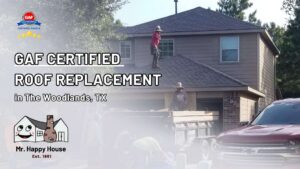
If you’ve started collecting quotes for a roof replacement in The Woodlands, you’ve probably noticed that some contractors mention being “GAF Certified” and others don’t say anything about it at all. It can be easy to skim past — just another logo on a truck or a badge on a website. But this distinction actually affects something that matters a lot to homeowners: what kind of warranty protection you end up with once the job is done.
Here’s a breakdown of what GAF Certification actually means, why it exists, and how it can affect the long-term protection on your new roof.
GAF is the largest roofing manufacturer in North America, and millions of homes across the country are roofed with their shingles. But here’s the thing — GAF doesn’t certify every contractor who installs their products. Certification is something a roofing company has to apply for and maintain, and it comes with ongoing requirements.
To become and remain GAF Certified, a contractor generally has to maintain proper state licensing, carry adequate liability insurance, and demonstrate a consistent track record of quality installations and customer satisfaction. GAF reviews and monitors certified contractors on an ongoing basis — certification isn’t a one-time badge a company earns and keeps forever regardless of performance.
In practical terms, this means GAF Certification is the manufacturer putting its own name behind the installer, not just the shingle. Any contractor can buy GAF shingles from a supply house and put them on your roof. Far fewer have gone through the process of being vetted and certified by GAF directly. That distinction matters more than most homeowners realize — because it directly affects the warranty coverage available to you.
This is the part that catches a lot of homeowners off guard: two roofs can be installed with the exact same GAF shingle, by two different contractors, and end up with two very different levels of warranty protection.
When a GAF Certified contractor installs a complete GAF roofing system — meaning the shingles along with compatible GAF underlayment, starter strips, ridge cap, and ventilation components, all installed together as a system rather than mixed with other brands — that installation can qualify for GAF’s System Plus Limited Warranty. This warranty extends coverage beyond what’s available through a standard installation, covering the roofing system as a whole rather than just the shingle product itself.
A non-certified contractor installing the same shingle, especially if they’re mixing in non-GAF accessories to save money, typically can’t offer that same level of system-wide coverage. The shingle itself may still carry its base manufacturer warranty, but the extended protection that comes from GAF backing the entire installed system isn’t available.
The takeaway: when you’re comparing quotes, “GAF shingles” on two different proposals doesn’t necessarily mean “the same warranty.” Who installs it, and what’s installed alongside it, makes a real difference in what you’re actually covered for.
A roof’s lifespan on paper and its actual lifespan on your house are two different things — and the gap between them usually comes down to installation quality, not the shingle itself.
The Woodlands deals with intense summer heat, high humidity for much of the year, occasional hail, and the kind of straight-line winds that come with strong thunderstorms. All of that puts stress on a roof system, and small installation mistakes that might not matter much in a milder climate can turn into real problems here. Improper attic ventilation can trap heat and moisture, accelerating shingle aging from underneath. Incorrect nailing patterns can leave shingles vulnerable to wind uplift in the next big storm. Flashing that isn’t sealed correctly around chimneys, vents, or roof-to-wall transitions is one of the most common sources of leaks — and it’s almost entirely an installation issue, not a materials issue.
GAF Certification standards exist, in part, to address exactly these kinds of installation details. A certified contractor has been trained on — and is expected to follow — installation practices that hold up under real-world conditions, not just pass a visual inspection from the ground.
There’s also a cost-of-ownership angle that’s easy to overlook when comparing quotes. A roof that’s installed correctly and ages predictably means fewer surprise repairs, fewer insurance claims for issues that turn out to be installation-related rather than storm-related, and a clearer picture of when the roof will actually need attention again. A slightly higher upfront quote from a certified contractor doing the job to standard can easily cost less over the life of the roof than a lower bid that runs into ventilation or flashing issues a few years down the line.
In practice, here’s what separates a GAF Certified roof replacement from a basic “tear off and reshingle” job.
It starts with a full tear-off, not a layover — installing new shingles directly over old ones can void warranty eligibility and traps heat, and it also means nobody’s actually looking at the roof deck underneath. Once the old roofing is removed, the deck gets inspected for soft spots, water damage, or rot, and any damaged decking gets replaced before anything new goes down — not covered up.
From there, the installation uses a complete GAF system: GAF underlayment, GAF starter strip along the edges, the chosen GAF shingle line, and GAF ridge cap — all designed to work together rather than mixing in whatever’s cheapest from different manufacturers. Proper attic ventilation is checked and addressed as part of the job, since ventilation directly affects both shingle lifespan and the System Plus warranty eligibility. Flashing around chimneys, vents, skylights, and roof-to-wall transitions is installed or replaced correctly — these are the details that determine whether a roof leaks in year three or stays watertight for decades.
The end result is a roof that’s not just made of good materials, but installed as a system that GAF itself is willing to back with extended warranty coverage.
This is also where the “full exterior” approach matters again. If the tear-off reveals rotted fascia, soffit damage, or decking that’s been compromised by a slow leak, that gets identified and addressed as part of the same project — not flagged for “someone else” to deal with later, and not quietly shingled over. A roof replacement is often the one time everything underneath is actually visible, and it’s the best opportunity to catch and fix problems before they’re hidden again for another 20-plus years.
The word “lifetime” gets thrown around a lot in roofing marketing, and it’s worth clearing up a few things.
First, “lifetime” coverage on materials and warranty coverage on workmanship (labor) are two different things. A shingle might carry a long-term material warranty regardless of who installs it, but if that installation has a defect — say, a nailing error that causes shingles to blow off in a storm — the labor/workmanship side of the warranty is what addresses that, and it’s often where coverage differs the most between certified and non-certified installers.
Second, “lifetime” doesn’t mean a roof is guaranteed to last forever no matter what happens to it — it typically refers to coverage for as long as the original homeowner owns the property, and is subject to the specific terms of that shingle line’s warranty documentation.
Third, and most importantly: not every contractor putting GAF shingles on a roof can offer the same warranty terms, even if their marketing materials say “GAF” prominently. The certification status of the installer is what unlocks the extended system coverage — it’s not automatic just because GAF shingles are involved.
Here’s a useful tip for any homeowner comparing roofing quotes, not just for us: GAF maintains a public contractor locator on its website where you can search for certified contractors by name and location. It takes about thirty seconds to check whether a company’s certification claim is actually current and verifiable directly through the manufacturer — rather than just taking a website’s word for it.
Mr. Happy House is listed there as a GAF Certified contractor serving The Woodlands and the surrounding area, and that listing is publicly verifiable any time.
A roof replacement is one of the more significant investments a homeowner makes, and the difference between a “GAF shingle” and a “GAF Certified installation” can directly affect what kind of warranty protection you’re left with for years to come. When you’re comparing quotes, it’s worth asking not just what shingle is being proposed, but whether the contractor is GAF Certified, whether a full GAF system is being installed, and what warranty coverage that specific combination actually qualifies for.
If you’re planning a roof replacement and want to understand what GAF Certified coverage would look like for your specific home, reach out to Mr. Happy House to talk through your options and get a quote based on your roof’s size, slope, and condition.
We hoped you loved this article about why it's important to hire a GAF Certified Roofer in The Woodlands, please share and tune in for more roofing, siding, and house painting content!
Our Services:

Storm Damage Roofing Claims in The Woodlands: How Mr. Happy House Helps
Storm Damage Roofing Claims in The Woodlands: How Mr. Happy House Helps Storm Damage Roofing Claims in The Woodlands: How Mr. Happy House Helps After

GAF Certified Roof Replacement in The Woodlands: What It Means for Your Home
GAF Certified Roof Replacement in The Woodlands: What It Means for Your Home GAF Certified Roof Replacement in The Woodlands: What It Means for Your

How to Spot Hail Damage on Your Roof in The Woodlands
How to Spot Hail Damage on Your Roof in The Woodlands How to Spot Hail Damage on Your Roof in The Woodlands If you’ve lived