Storm Damage Roofing Claims in The Woodlands: How Mr. Happy House Helps
Storm Damage Roofing Claims in The Woodlands: How Mr. Happy House Helps Storm Damage Roofing Claims in The Woodlands: How Mr. Happy House Helps After
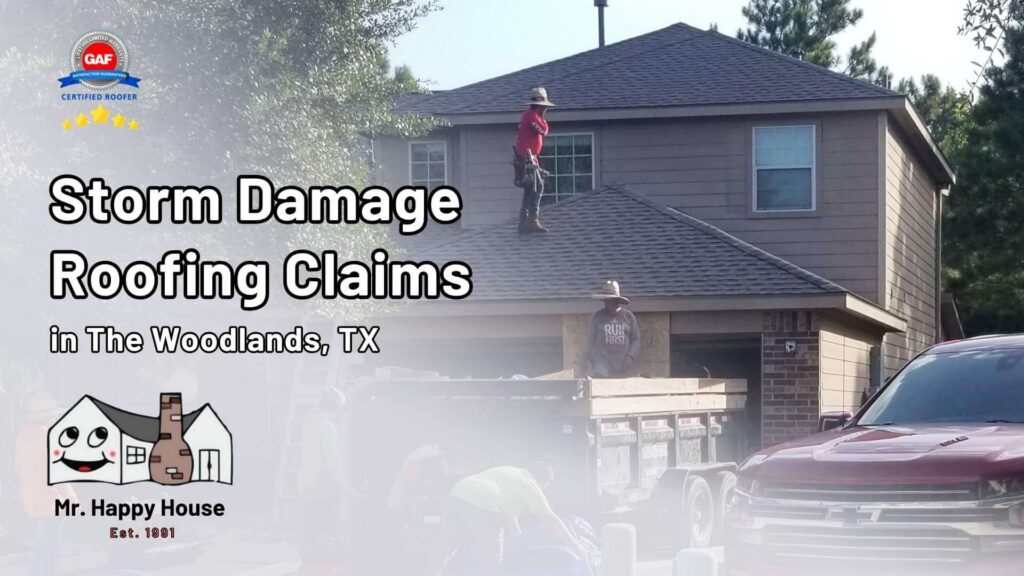
After a storm rolls through The Woodlands, a lot of homeowners end up facing the same question: do I call my insurance company first, or get my roof looked at first? It feels like it shouldn’t matter much, but the order you do things in can actually affect how smoothly the whole process goes — and what you end up with at the end of it.
Here’s how the process actually works, what role a roofing contractor can (and can’t) play in it, and how Mr. Happy House helps homeowners through it.
Right after a storm, before calling anyone, it’s worth doing a quick walk-around of your property — the kind of check we covered in a previous article on spotting hail damage. Dented gutters, marks on your AC unit, damaged window screens, or anything unusual on the ground gives you a first sense of whether your property took a real hit.
From there, the better next step is usually getting a professional roof inspection — not filing a claim first and hoping the roof matches whatever was reported. Mr. Happy House provides a full roof inspection with a detailed written report for $35–$95, depending on the size and complexity of the roof. That report tells you what’s actually going on up there: whether there’s genuine storm damage, how extensive it is, and whether it’s the kind of damage that’s typically covered.
Having that information in hand before you file a claim means you’re not guessing about what you’re reporting — and if you do decide to file, you’re doing it with a clear picture of what’s there.
There’s also a downside to doing it the other way around. If a claim is filed before anyone has actually looked at the roof, and the resulting adjuster visit doesn’t turn up much — because nothing was pointed out, or the damage wasn’t described accurately — that claim can end up denied or significantly underpaid. A denial on record can also make it harder to revisit the issue later, even if more damage becomes apparent down the line. Starting with an inspection avoids that situation entirely.
It’s worth being clear about this, because there’s sometimes confusion about what role a roofing contractor actually plays in an insurance claim.
A roofing contractor is not a public adjuster, and doesn’t negotiate your claim on your behalf in any official capacity — that’s a separate, licensed role. What a contractor like Mr. Happy House can do is document the damage thoroughly with photos and a written report, and be present during the insurance adjuster’s inspection of your roof.
That second part matters more than it might sound. An insurance adjuster typically covers multiple properties in a day, often inspecting roofs they’re not specialized in, looking for damage across a wide range of issues. A contractor whose only job that day is your roof — and who’s trained to recognize what storm damage on shingles actually looks like — can point out specific areas during that walkthrough that might otherwise be assessed quickly and moved past.
In practice, this often means the difference between an adjuster’s report that captures the full extent of the damage versus one that captures only the most obvious parts of it.
This is where the GAF certification and years of local experience actually translate into something practical for homeowners.
Recognizing hail damage on shingles isn’t always straightforward — bruised shingles, granule loss in specific patterns, and cracking from wind uplift can look subtle to someone who isn’t looking at roofs every day. Mr. Happy House has handled this exact situation many times across The Woodlands, Spring, Tomball, Magnolia, and Conroe, and knows what to look for and how to point it out in terms that align with how adjusters evaluate damage.
Several Mr. Happy House customers have specifically described this in their reviews — being present for the adjuster’s visit, walking through the roof together, and identifying damage that the customer wouldn’t have known to look for or describe on their own. That kind of attention to detail during the inspection is often what determines whether a claim accurately reflects what’s actually wrong with the roof.
Here’s something that’s easy to overlook in the middle of dealing with a roof claim: the same storm that damaged your shingles likely affected other parts of your home’s exterior too.
Gutters get dented or torn loose in high winds. Fascia and soffit can be damaged by the same hail or wind that hit the roof, and sometimes show up as a secondary leak point even after the roof itself is repaired. Siding near the roofline can crack or dent from the same hail. If a claim only addresses the roof, and nobody documents the rest, that other damage either goes unclaimed entirely or becomes a separate, harder conversation later.
For example, a homeowner might file a roof claim after a hailstorm, get the roof replaced, and then notice a few months later that water is still getting into the attic near the eaves — not because the roof repair failed, but because hail-damaged soffit panels from the same storm were never identified or addressed. At that point, it’s a separate repair, on a separate timeline, and depending on how much time has passed, it may be harder to connect it back to the original storm for insurance purposes.
Because Mr. Happy House handles roofing, siding, fascia, soffit, and gutters as part of the same inspection, storm damage to any of these components gets documented together — as part of the same overall picture of what the storm actually did to your home, rather than as a roof-only assessment that misses everything else.
Most homeowner’s insurance policies have a window of time for filing a claim after a storm event — and while the exact timeframe depends on your specific policy, the general principle is the same: the sooner damage is documented after a storm, the better.
This doesn’t mean you need to rush into filing a claim immediately. It means getting an inspection and a written report soon after a storm gives you the option to file later if needed, with documentation that reflects the damage close to when it actually happened — rather than trying to document storm damage months later, when it’s harder to connect it clearly to a specific event.
Once a claim is approved, the insurance company typically provides a scope of work — essentially, a list of what they’ve agreed to cover and the amount allocated for it. From there, Mr. Happy House works from that scope to complete the roof replacement or repair.
Sometimes, once the work actually begins — during tear-off, for example — additional damage is found that wasn’t visible during the initial inspection, such as damaged decking or fascia that was hidden under the old roofing. When that happens, it’s often possible to document the newly found damage and submit it to the insurance company as a supplement to the original claim, so it can be addressed as part of the same project rather than becoming a separate out-of-pocket repair later.
Sometimes an initial claim comes back denied, or with a payout that doesn’t seem to match the actual damage. This can happen for a few reasons — the adjuster may not have spent much time on the roof, certain damage may not have been clearly visible during their visit, or the report may not have fully captured what’s there.
In these situations, a second, more detailed inspection report — documenting specific areas of damage with photos and a written description — can sometimes support a request for re-inspection or an appeal of the initial decision. This isn’t a guarantee of a different outcome, since the final decision rests with the insurance company, but having thorough documentation gives homeowners something concrete to work from if they want to revisit the claim.
Dealing with storm damage and an insurance claim at the same time can feel overwhelming, especially if you’re not sure what’s actually wrong with your roof or what to expect from the process. Getting a professional inspection first — before filing anything — gives you a clear, documented starting point. From there, Mr. Happy House can be present for the adjuster’s visit to make sure the full extent of the damage, across your roof, siding, fascia, soffit, and gutters, actually gets seen and accounted for.
If you’ve had recent storm damage in The Woodlands and aren’t sure where to start, Mr. Happy House offers a full inspection with a written report for $35–$95, with that fee applied toward the project if you move forward — giving you documentation either way, and support through the claims process if you decide to file.
We hoped you loved this article about why it's important to hire a GAF Certified Roofer in The Woodlands, please share and tune in for more roofing, siding, and house painting content!
Our Services:

Storm Damage Roofing Claims in The Woodlands: How Mr. Happy House Helps
Storm Damage Roofing Claims in The Woodlands: How Mr. Happy House Helps Storm Damage Roofing Claims in The Woodlands: How Mr. Happy House Helps After

GAF Certified Roof Replacement in The Woodlands: What It Means for Your Home
GAF Certified Roof Replacement in The Woodlands: What It Means for Your Home GAF Certified Roof Replacement in The Woodlands: What It Means for Your

How to Spot Hail Damage on Your Roof in The Woodlands
How to Spot Hail Damage on Your Roof in The Woodlands How to Spot Hail Damage on Your Roof in The Woodlands If you’ve lived